Principal

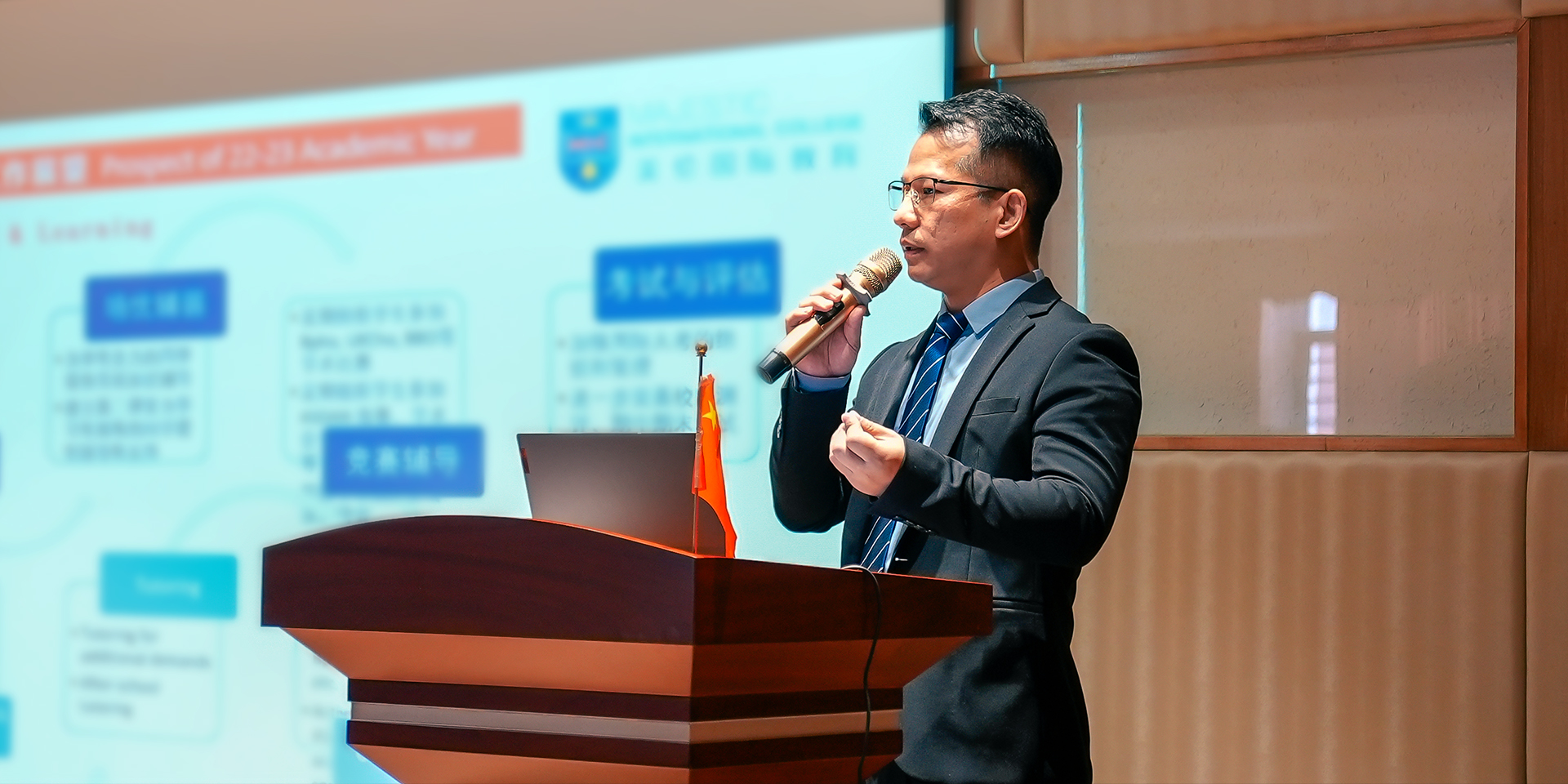
"At the starting point of its fifth anniversary, how should MIC move forward? This is a question I have been pondering," said Feng , Principal of MIC International Education. MIC will remain steadfast in its educational mission of "cultivating internationally elite talents who possess both a deep appreciation for traditional Chinese culture and a global vision, capable of shaping the future." Upholding a student-centered approach, MIC prioritizes student growth and development, strengthens faculty development, and attracts top talent from around the world. Beyond this, MIC will benchmark itself against world-class high schools, learn from successful experiences, and adhere to a professional and internationalized educational philosophy, nurturing future global elites who can "go global and return home" for the nation and society.
Like a dark horse in the Greater Bay Area's international education sector, MIC has rapidly gained recognition for its unique advantages, competitiveness, advanced teaching philosophy, pragmatic educational practices, and outstanding achievements. It serves as a bridge for students eager to broaden their horizons and study abroad, helping them gain admission to prestigious global universities. "From MIC to the World" and "Becoming a Better Version of Yourself at MIC" are not just slogans prominently displayed in the school's lobby—they are realities as MIC students shine in universities across the globe.
How Will MIC Move Forward?
This is a question of concern not only to faculty and students but also to supporters of MIC's development in the broader community. Recently, the MIC International Branding Department interviewed Principal Feng , who provided a clear and resolute answer.
Principal Feng has a rich professional background. He holds a master's degree from the University of Manchester and is currently pursuing a doctorate in education at the University of Hong Kong. With 20 years of experience in education, teaching, and administration, he is one of China's earliest pioneers in international high school education. He possesses extensive industry management expertise, a deep understanding of international education operations and teaching management, and adheres to a holistic education philosophy that balances academic achievement with comprehensive development.
He has served as a teacher, principal, and school operations manager at several renowned international education groups and schools in cities like Shanghai and Guangdong. Over the past two decades, he has witnessed and contributed to the inception, growth, and evolution of international education in China. As a core member, he helped establish and manage two international high schools that have since become top-tier institutions in the country, working with his team to send over 300 outstanding students to universities such as Oxford, Cambridge, and the Ivy League.
He believes that under the careful cultivation of successive principals, leadership teams, faculty, and students, MIC has developed seven distinctive features and advantages—its core competitiveness. Moving forward, by adhering to the "holistic education" philosophy, benchmarking against world-class high schools, learning from successful models, continuously improving management and teaching standards, strengthening faculty development, attracting global talent, and fostering home-school collaboration, MIC will achieve even greater success.
Interview Transcript
Q: Having served as a teacher and principal at several renowned international schools, what competencies do you believe international schools should focus on developing in students?
Personally, I believe we should focus on cultivating students' future competencies, including the ability to adapt to and shape the future. We cannot educate students based on past or present standards; we must adopt a forward-looking perspective. The world is changing every day, and we cannot precisely predict what the future will look like. Therefore, we cannot set a fixed standard for students' abilities, but adaptability and creativity are essential.
Q: What future-ready skills can students gain from overseas learning experiences?
With advancements in technology and the economy, global interconnectedness and interdependence are deepening. It is no longer possible to remain isolated, requiring us to view, analyze, and solve problems from a global perspective. Students with overseas learning experiences are more likely to develop a global mindset, draw insights from different cultures and civilizations, and "know themselves and others," making them more adaptable and successful in future competition and collaboration.
Q: From Shanghai to Foshan, how do you perceive the differences in international education development between the Greater Bay Area and the Yangtze River Delta?
Having worked in Shanghai for over a decade and now in Foshan, albeit for a shorter time, I honestly do not see significant differences in international education between the two regions. In the information age, knowledge and information flow seamlessly across the country. The Yangtze River Delta and the Pearl River Delta frequently exchange ideas and experiences, and talent mobility is high. Families opting for international education have diverse considerations, but most share a recognition of its educational philosophy—moving beyond exam-centric standards and embracing "holistic education."
If there are differences, they lie in the developmental foundation. International education in the Yangtze River Delta started earlier, and as education requires time to mature, the region has more experience and achievements. The Pearl River Delta started slightly later but from a higher baseline, allowing it to learn from successful models and avoid pitfalls. Currently, the region shows immense potential, with international education achieving increasingly impressive results in recent years.
Q: What educational philosophy do you uphold?
Confucius advocated "teaching students according to their aptitude," American educator John Dewey emphasized "student-centered, activity-centered, and experience-centered" education, and renowned Chinese educator Tao Xingzhi proposed "life as education." I deeply admire and endorse these philosophies and strive to implement them in practice.
As the principal of an international high school, I advocate for a holistic education approach that balances academic achievement with comprehensive development, tailored to students' individualized growth and future needs. This philosophy reflects my 20 years of experience in international education.
Q: What do you consider MIC's competitive advantages?
First, MIC is located in the heart of the Greater Bay Area, with convenient transportation, a beautiful campus, state-of-the-art facilities, and abundant educational resources. Second, Foshan's rich cultural heritage and economic prosperity enable us to attract top-tier faculty and talent nationwide and globally. Third, since its founding, MIC has articulated a clear vision: to become "a top-tier international curriculum high school in the Greater Bay Area" and cultivate "internationally elite talents with traditional Chinese cultural values, a global vision, and the ability to shape the future."
Fourth, MIC has assembled a dedicated, professional, and passionate team of faculty and staff from China and abroad. Fifth, our IGCSE/A-Level and Canadian BC curricula cater to diverse student needs, offering distinct advantages in course design, assessment, and examinations. Sixth, over five years, MIC has achieved remarkable results, attracting outstanding students. Seventh, as our reputation grows, we have garnered widespread support from society, including parents, alumni, and organizations. Beyond these, MIC has many other strengths, and we welcome the community to visit and engage with us.
Q: How will you implement holistic education at MIC?
Holistic education is not about being "broad and all-encompassing" in a literal sense but about tailoring education to students' individualized growth and future needs, considering their personalities, strengths, and aspirations.
Every student is unique, with their own talents and potential. We cannot educate them using a one-size-fits-all approach or focus solely on academics while neglecting leadership, critical thinking, practical skills, collaboration, perseverance, compassion, cross-cultural understanding, scientific literacy, and artistic appreciation—or vice versa. Academic success and comprehensive development are mutually reinforcing.
MIC offers both IGCSE/A-Level and Canadian BC curricula, each with distinct advantages. We rigorously adhere to international standards in faculty recruitment, training, teaching, research, assessment, and examinations. Additionally, we implement differentiated instruction and targeted support to enhance students' academic performance, English proficiency, and practical skills.
To foster students' individualized growth and comprehensive abilities, we support student-led clubs, organize diverse activities and competitions, and encourage students to showcase their talents on broader platforms. We guide and support students in participating in international academic competitions, research projects, volunteer work, summer programs at top universities, and academic summits, further cultivating their subject mastery, scientific spirit, leadership, and social responsibility.
The school is both a family and a community. We hope all faculty, parents, and supporters will collaborate with a student-centered focus, following educational principles to safeguard students' growth and development.
Q: As MIC enters its fifth year, how will it build on its existing foundation to achieve greater success?
This is a question I continually reflect on. Over the past five years, MIC has achieved outstanding results, and I am confident we will accomplish even more in the future.
First, we will remain committed to our founding vision: "building a top-tier international curriculum high school in the Greater Bay Area" and our mission of "cultivating globally elite talents with traditional Chinese cultural values, a global vision, and the ability to shape the future." Staying true to our初心 (original aspirations) is key.
Second, we will always prioritize students, placing their growth and development at the forefront and providing the necessary resources and support. Third, we will continue strengthening our faculty, attracting and retaining top educators to join MIC.
Finally, but no less importantly, we will benchmark against world-class high schools, learn from their successes, and continuously elevate our management and teaching standards. By collaborating with parents and upholding our professional and internationalized educational philosophy, we will nurture future global elites who can "go global and return home," contributing to our nation and society.
